24/7 Emergency Water Extraction — Live dispatch for Columbia, Laurel, Ellicott City, Beltsville & Greenbelt
Menu
Home
Services
Emergency Water Extraction
Flooded Basement Water Removal
Burst Pipe Water Cleanup
Appliance Flood Cleanup
Sewage Backup Cleanup
Structural Drying & Dehumidification
Service Areas
Columbia, MD
Laurel, MD
Ellicott City, MD
Beltsville, MD
Greenbelt, MD
Company
About Us
Contact Us
Call 24/7 — (216) 245-3187
Home / Columbia, MD / Structural Drying & Dehumidification
24/7 Structural Drying · Columbia, MD
Structural Drying & Dehumidification in Columbia, MD
Water is gone but walls and floors are still wet in your Columbia home? Call any hour for structural drying and dehumidification that stops hidden moisture and mold across 21044 to 21046.
Calls answered 24/7/365
Local Maryland providers
Free phone assessment
Water Damage Emergency?
Call now — local water extraction crews in Howard & Prince George's County are on standby day and night.
Answered 24 hours, 7 days a week
Matched with a provider near your ZIP
Photos & moisture logs for your claim
Free to call — no obligation
Free phone assessment · Estimate before any work begins

Columbia Structural Drying
Professional Drying Built for Columbia's Humid Summers
Columbia summers are humid, especially in July and August, and that works against you after a leak. Damp air slows natural drying, so water trapped in framing, subfloors, drywall and concrete can linger long enough for mold to start.
Crews set high-velocity air movers alongside low-grain refrigerant (LGR) or desiccant dehumidifiers, then take readings every day until each material is back to its normal moisture level. See how structural drying and dehumidification works.
Drying plans are built around each property, from a single wet kitchen in a Wilde Lake rambler to a whole-floor loss in a River Hill colonial.
Air movers and LGR dehumidifiers
Desiccant drying for dense materials
Daily moisture readings
Drying logs for your insurer
What We Dry
Structural Drying for Every Part of a Columbia Home
Different materials dry at different speeds. These are the areas that usually need specialized drying, each with a Columbia page.
Hardwood Floors
Floor drying mats pull moisture up through the boards to limit cupping.
Learn more →
Wall Cavities
Injection drying pushes dry air inside walls without tearing them open.
Learn more →
Ceilings
Ceiling cavities are dried with targeted airflow after leaks from above.
Learn more →
Basements and Concrete
Concrete slabs and block walls hold water and take the longest to dry.
Learn more →
Crawl Spaces
Joists and subfloor are dried with dehumidifiers until wood readings are normal.
Learn more →
Commercial Buildings
Large-loss drying plans help Columbia offices and shops stay open where possible.
Learn more →
How It Works
What Happens When You CallNo phone trees, no runaround. One call gets the extraction process moving — here is exactly what to expect.
1
Call & Describe the ProblemTell us where the water is coming from, how much there is and which rooms are affected. If the source is still running, we walk you through shutting off the main valve.
2
Get Connected to a Local ProYour call is routed to an available, local water extraction provider who serves your ZIP code and can confirm an arrival window.
3
Inspection & Written EstimateThe technician inspects the damage, maps moisture with meters and explains the plan and pricing before any work begins.
4
Extraction, Drying & MonitoringTruck-mounted or portable extractors pull the water out, then air movers and dehumidifiers dry the structure while readings are checked until it is dry.
How It Works
Why Columbia Homes Need More Than Box Fans
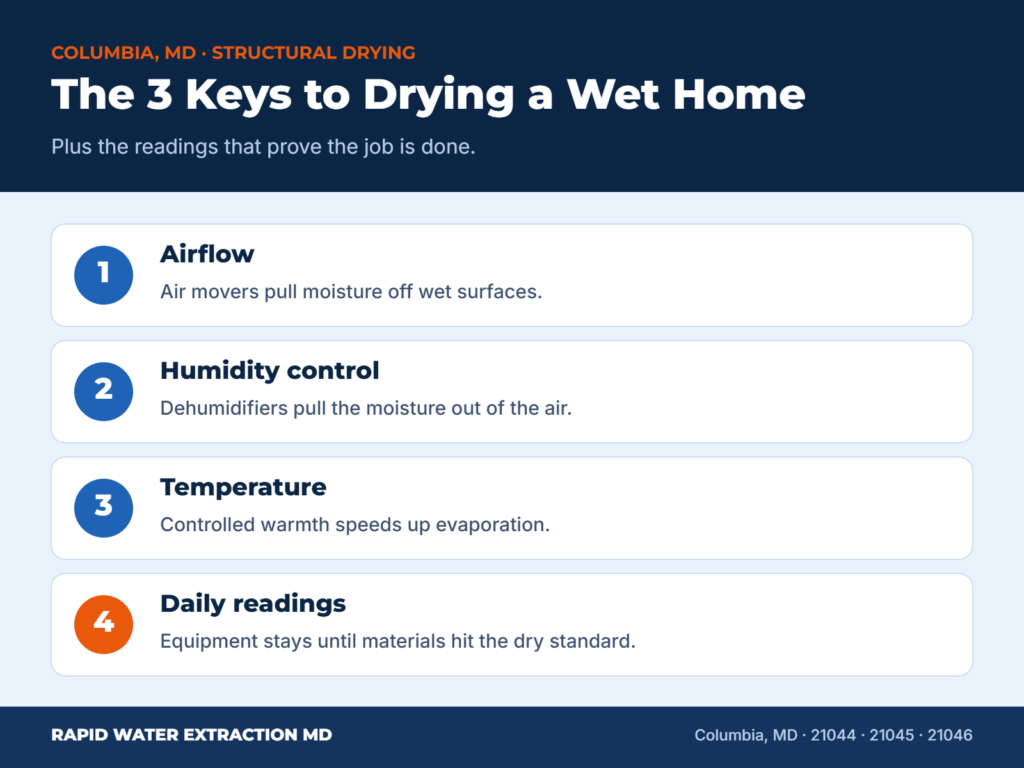
Drying depends on three things: airflow, humidity and temperature. Moving air lifts water off surfaces, dehumidifiers capture it before it settles somewhere else, and gentle heat makes it evaporate faster.
Box fans move air but don't remove humidity, so on a muggy Columbia day moisture just moves from the floor into the walls. LGR dehumidifiers keep pulling water out of the air even as humidity drops.
Technicians compare readings with dry, unaffected materials in your home, and the equipment stays until readings reach that standard, not just until surfaces feel dry.
Airflow: air movers
Humidity: LGR and desiccant dehumidifiers
Temperature: controlled heat
Proof: daily moisture readings
Why Call Us First
Fast Help Without the RunaroundSearching through a dozen contractor listings while water soaks into your floors wastes time you do not have. One call to Rapid Water Extraction MD gets you to someone local who can help.
Nights, weekends and holidays — water emergencies do not keep business hours and neither does our phone line.
Calls are matched to providers who actually work in Howard and Prince George's County, so help is not coming from two hours away.
Providers bring commercial extractors, submersible pumps, air movers and dehumidifiers — far beyond a shop-vac and box fans.
Your provider explains the scope and pricing on site and gets your OK before extraction begins. No surprise invoices.
Photos, moisture readings and drying logs help support your claim. Many providers can also coordinate with your adjuster.
There is no charge for the call or the phone assessment. You only pay the provider for work you approve.
Questions & Answers
Structural Drying in Columbia FAQ
Why does drying take longer in the summer?
Columbia's humid summer air already holds a lot of moisture, so dehumidifiers have to work harder. Sealing off the drying area and running LGR units keeps the job on schedule.
Can I turn the equipment off at night?
Please leave it running. Every hour it's off adds drying time and can leave gaps in the log your insurer reviews. Placement can be adjusted to cut down on noise.
Will the equipment raise my electric bill?
Yes, drying equipment uses electricity. Many insurance policies let you claim the added cost, so note the drying dates and ask your adjuster.
How long does structural drying take?
Most homes dry in three to five days. Plaster walls, hardwood, concrete and whole-floor losses tend to need extra days.
How do I know my home is really dry?
Readings are compared with dry areas of your home each day, and the drying log shows when every material reached its normal level.
More Help in Columbia
More Drying Help in Columbia
Service Areas & ZIP Codes
Water Extraction Across Howard & Prince George's County
We connect homeowners and businesses with local water removal pros in these Maryland communities. Find your ZIP code below, then open your city's page for local service details.
Not sure if you are covered? Call (216) 245-3187 — we will tell you right away.