24/7 Emergency Water Extraction — Live dispatch for Columbia, Laurel, Ellicott City, Beltsville & Greenbelt
Menu
Home
Services
Emergency Water Extraction
Flooded Basement Water Removal
Burst Pipe Water Cleanup
Appliance Flood Cleanup
Sewage Backup Cleanup
Structural Drying & Dehumidification
Service Areas
Columbia, MD
Laurel, MD
Ellicott City, MD
Beltsville, MD
Greenbelt, MD
Company
About Us
Contact Us
Call 24/7 — (216) 245-3187
Home / Columbia, MD / Water Heater Leak Cleanup
24/7 Water Heater Leak Cleanup · Columbia, MD
Water Heater Leak Cleanup in Columbia, MD
Water heater burst in your Columbia basement, garage or utility closet? Call any hour for water heater leak cleanup, extraction and drying from Wilde Lake to River Hill.
Calls answered 24/7/365
Local Maryland providers
Free phone assessment
Water Damage Emergency?
Call now — local water extraction crews in Howard & Prince George's County are on standby day and night.
Answered 24 hours, 7 days a week
Matched with a provider near your ZIP
Photos & moisture logs for your claim
Free to call — no obligation
Free phone assessment · Estimate before any work begins

Columbia Water Heaters
Water Heater Leak Cleanup for Columbia Homes
Tank water heaters usually last 8 to 12 years. In a community where many homes date to the 1970s and 1980s, plenty of Columbia houses are on their second or third tank, and some are running on one that is overdue.
When a tank fails, it can release its full 40 to 80 gallons, and the cold supply keeps feeding the leak until someone shuts it off. Crews extract the water, remove what can't be dried and dry the floors, drywall and the rooms below. More on water heater leak cleanup.
In Columbia homes the heater is usually in a basement utility room, a garage or a closet off the kitchen, so the water often reaches finished space quickly.
Extraction from utility rooms and basements
Removal of soaked boxes and storage
Drywall and baseboard drying
Checks of finished rooms beside and below
Where the Water Goes
What a Water Heater Leak Affects in Columbia Homes
Where your heater sits decides where the water goes next. These are common paths, with Columbia pages for each.
Finished Basements
Heaters in basement utility rooms flood the family room or guest room next door first.
Learn more →
Ceilings Below
Heaters in upstairs closets or attics in townhomes can leak through to the floor underneath.
Learn more →
Wall Cavities
Water wicks up drywall and collects inside the walls around the utility room.
Learn more →
Hardwood Floors
Kitchen-area closets put wood floors right in the path of a leaking tank.
Learn more →
Supply Line Failures
Leaks at fittings and supply lines can drip for weeks before the tank itself fails.
Learn more →
Drying the Space
Air movers and dehumidifiers dry the room, and moisture readings confirm when it is done.
Learn more →
How It Works
What Happens When You CallNo phone trees, no runaround. One call gets the extraction process moving — here is exactly what to expect.
1
Call & Describe the ProblemTell us where the water is coming from, how much there is and which rooms are affected. If the source is still running, we walk you through shutting off the main valve.
2
Get Connected to a Local ProYour call is routed to an available, local water extraction provider who serves your ZIP code and can confirm an arrival window.
3
Inspection & Written EstimateThe technician inspects the damage, maps moisture with meters and explains the plan and pricing before any work begins.
4
Extraction, Drying & MonitoringTruck-mounted or portable extractors pull the water out, then air movers and dehumidifiers dry the structure while readings are checked until it is dry.
Right Now
Water Heater Leaking in Your Columbia Home? Start Here
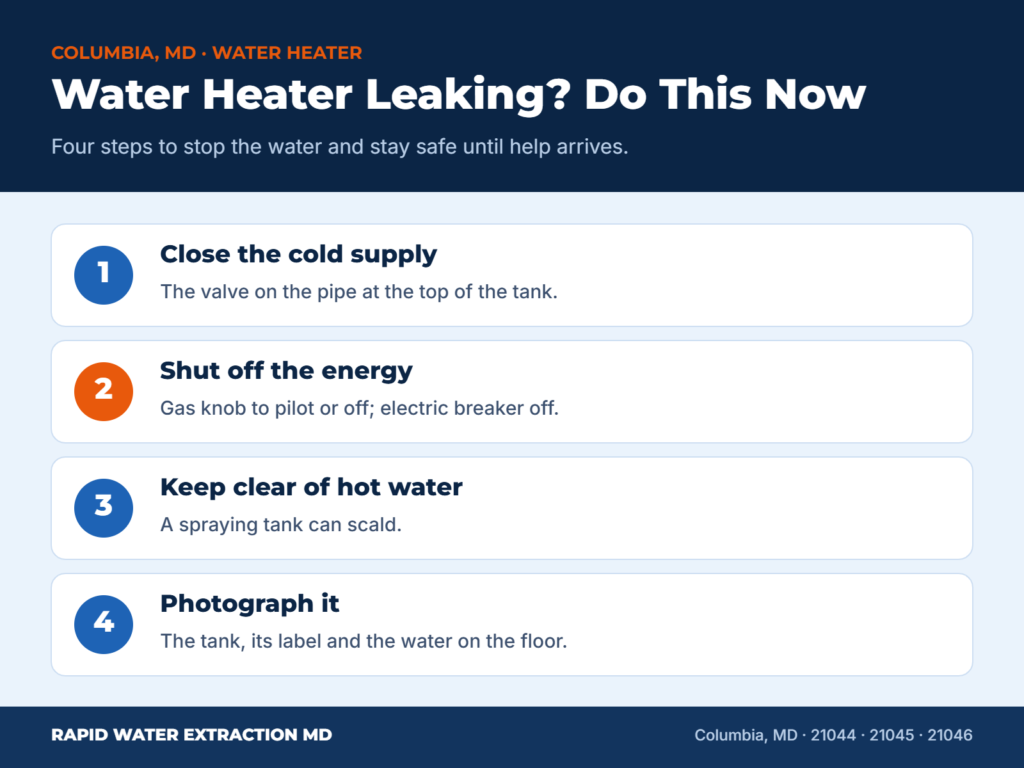
Turn off the cold-water valve on the pipe feeding the top of the tank. Then cut the energy: set a gas unit's dial to pilot or off, or flip the breaker for an electric one.
If you can't reach the tank valve, shut off the main water to the house. Hot water can scald, so stay clear of a tank that is actively spraying.
Move stored boxes off the floor and take photos of the tank and the water for your insurance company before anything is moved.
Close the cold supply valve
Gas to pilot, or electric breaker off
Keep clear of hot spraying water
Photos before cleanup
Why Call Us First
Fast Help Without the RunaroundSearching through a dozen contractor listings while water soaks into your floors wastes time you do not have. One call to Rapid Water Extraction MD gets you to someone local who can help.
Nights, weekends and holidays — water emergencies do not keep business hours and neither does our phone line.
Calls are matched to providers who actually work in Howard and Prince George's County, so help is not coming from two hours away.
Providers bring commercial extractors, submersible pumps, air movers and dehumidifiers — far beyond a shop-vac and box fans.
Your provider explains the scope and pricing on site and gets your OK before extraction begins. No surprise invoices.
Photos, moisture readings and drying logs help support your claim. Many providers can also coordinate with your adjuster.
There is no charge for the call or the phone assessment. You only pay the provider for work you approve.
Questions & Answers
Water Heater Leak Cleanup in Columbia FAQ
Does a leak at the bottom mean the tank is done?
Usually. A leak from the bottom of the tank typically means internal corrosion. A drip from a fitting, the drain valve or the pressure relief valve can sometimes be fixed without replacing the heater.
How much water can one tank put on my floor?
Everything in it, usually 40 to 80 gallons, and more if the cold supply keeps running.
Will insurance pay for a new water heater?
Usually not. Policies often cover the water damage from a sudden failure, but not the worn-out heater itself.
Who replaces the water heater?
A licensed plumber. Water extraction providers handle cleanup and drying, and many can recommend a plumber locally.
How long does cleanup take?
Usually two to four days for a contained leak, and longer if water spread under flooring or into finished walls.
More Help in Columbia
More Appliance Help in Columbia
Service Areas & ZIP Codes
Water Extraction Across Howard & Prince George's County
We connect homeowners and businesses with local water removal pros in these Maryland communities. Find your ZIP code below, then open your city's page for local service details.
Not sure if you are covered? Call (216) 245-3187 — we will tell you right away.